
FACTS THAT ARE PRACTICALLY HIDDEN Entry #4
How I Learned What Most Voters Never See
I didn’t plan to write this. It started in the voting booth. I stood there yesterday, staring at names, candidates, propositions, and offices, and I realized something that hit me harder than I expected: I didn’t know which of these people had ever done anything for homelessness. That moment pushed me into researching the hidden history of homelessness, the part voters never see. I stood there yesterday, staring at names, candidates, propositions, and offices, and I realized something that hit me harder than I expected:
Not really.
Not beyond the slogans.
Not beyond the mailers.
Not beyond the headlines.
And if I didn’t know someone who lives this work, who studies homelessness, who watches the system every day, then how many voters know?
How many unhoused people know?
How many taxpayers know?
That question bothered me enough that I went digging.
And what I found wasn’t simple.
It wasn’t clean.
It wasn’t in one place.
It wasn’t easy to track.
But it told a story, a story about how homelessness, mental health, immigration, disease control, and civil rights have all been shaped by policy decisions that most people never hear about.
This isn’t opinion.
This isn’t theory.
This is the timeline of how we got here, the facts that are practically hidden.
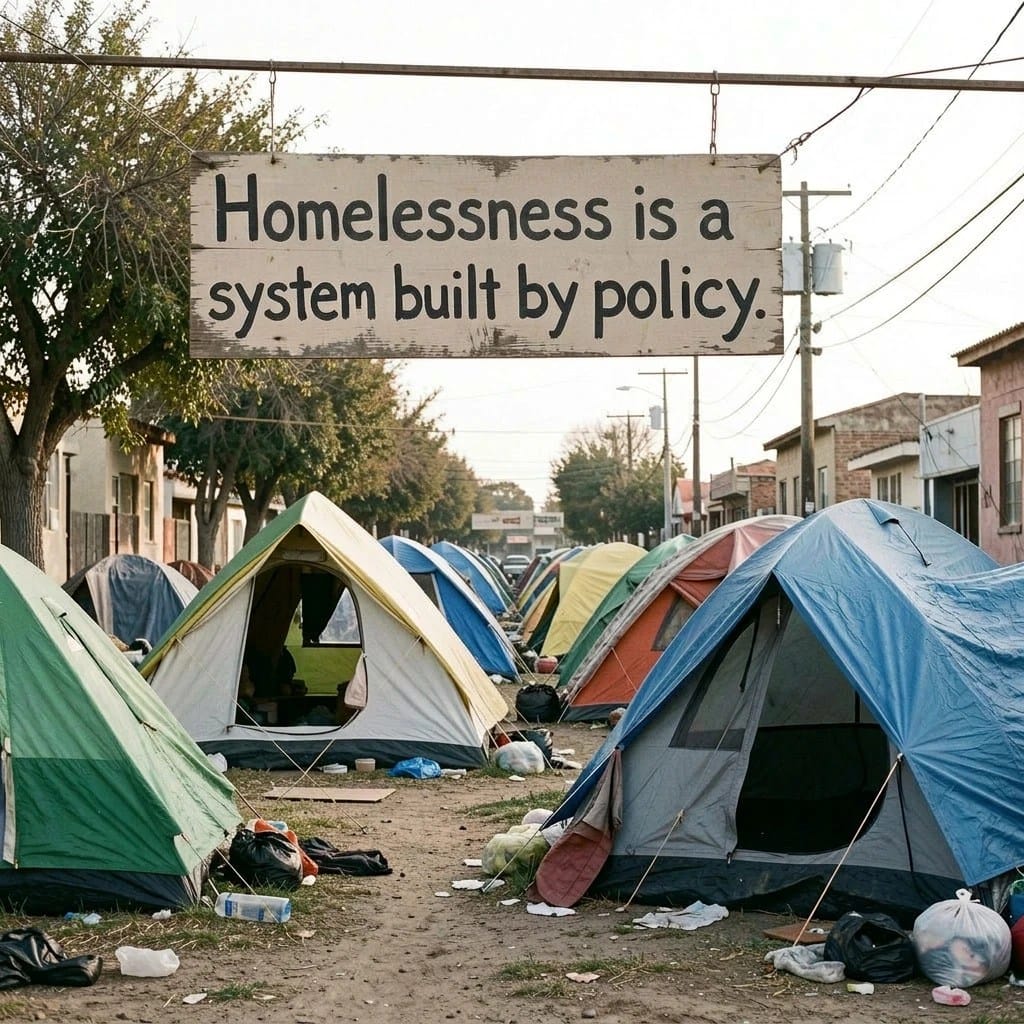
I. HOMELESSNESS – A SYSTEM BUILT BY POLICY, NOT ACCIDENT
1640 – 1870 – Early colonial laws criminalize poverty, vagrancy, and “idleness.”
1933 – The Great Depression forces the first federal conversations about mass homelessness.
1964 – The War on Poverty begins, but housing remains underfunded.
1987 – The McKinney‑Vento Act becomes the first major federal homelessness law.
1990 – 1997 – Cities shift toward criminalization instead of housing.
2020 – Reps. Ayanna Pressley and Rashida Tlaib introduce emergency grants to protect unhoused people during COVID‑19.
2021 – Rep.Tlaib introduces the Maintaining Access to Essential Services Act.
2023 – Tlaib reintroduces a $5B housing grant bill to rebuild distressed neighborhoods.
2023 – Members of Congress reestablish the Congressional Caucus on Homelessness.
2024 – The Youth Homelessness Guaranteed Income Pilot Program is introduced.
2025 – The program is reintroduced as youth homelessness worsens.
2026 – The Unhoused Persons Bill of Rights is reintroduced, calling for federal action.
The hidden history of homelessness shows how early laws criminalized poverty long before modern shelters existed.
II. CALIFORNIA – THE STATE WITH THE MOST HOMELESSNESS AND THE MOST LEGISLATION
California has more unhoused residents than any other state and more lawmakers trying to address it.
But their work rarely reaches voters.
Here are the California federal lawmakers who have introduced or co‑sponsored major homelessness legislation:
Rep. Maxine Waters (CA‑43)
- Lead sponsor of the Ending Homelessness Act (multiple sessions)
- Major federal housing funding advocate
Rep. Nanette Barragán (CA‑44)
- Co‑chair of the Congressional Caucus on Homelessness
- Introduced bills on shelter access and migrant homelessness
Rep. Barbara Lee (CA‑12)
- Longtime anti‑poverty and homelessness advocate
Rep. Jimmy Gomez (CA‑34)
- Introduced bills on housing vouchers and anti‑displacement
Rep. Katie Porter (CA‑47)
- Introduced bills targeting corporate landlords and housing affordability
Rep. Judy Chu (CA‑28)
- Introduced mental‑health‑and‑housing access legislation
Rep. Ted Lieu (CA‑36)
- Co‑sponsored major homelessness and mental health bills
Rep. Sara Jacobs (CA‑51)
- Introduced youth homelessness and foster‑care‑to‑homelessness prevention bills
California is not silent.
But the public rarely hears about any of this.
III. MENTAL HEALTH – THE SYSTEM THAT EMPTIED INTO THE STREETS
1247 – Bethlehem Hospital (“Bedlam”) becomes the first institution for the mentally ill.
1773 – First public hospital for “insane and disordered minds” opens in the U.S.
1839 – Women’s Lunatic Asylum opens on Blackwell’s Island.
1843 – Dorothea Dix launches the American Asylum Movement.
1844 – The American Psychiatric Association forms.
1854 – The Indigent Bill is vetoed by President Franklin Pierce.
1886 – Freud begins developing psychoanalysis (“the talking cure”).
1891 – The Lunacy Act defines mental illness categories.
1907 – Indiana passes the first sterilization law targeting “criminals and the mentally ill.”
1913 – The Deficiency Act allows near‑permanent institutionalization.
1920 – Congress passes the Mental Health Act.
1927 – Insulin‑induced comas were used to treat schizophrenia.
1930 – Britain reframes mental illness as a medical issue.
1936 – First prefrontal lobotomy performed.
1938 –1939 – Electroshock therapy was introduced in Europe and the U.S.
1945 – Philadelphia State Hospital uses shackles in basements.
1946 – National Mental Health Act signed.
1949 – National Institute of Mental Health (NIMH) founded.
1952 – First DSM published.
1954 –1955 – Thorazine becomes the first widely used antipsychotic.
1963 – JFK makes mental health a national priority.
1967 – Johnson expands community mental health programs.
1980 – DSM‑III published; Mental Health Systems Act signed.
1981 – Federal mental health funding cut; mass closures follow.
2008 – Mental Health Parity Act.
2010 – Affordable Care Act expands mental health coverage.
2013 – WHO adopts global mental health plan.
2024 – Updated Mental Health Parity rules released.
Result:
When institutions closed without community systems to replace them, hundreds of thousands of people were pushed into homelessness.
This mental‑health timeline is a major part of the hidden history of homelessness, because deinstitutionalization pushed thousands into the streets.
IV. DISEASE CONTROL – HOW FEAR CREATES EXCLUSION
1873 – Leprosy was identified and named.
1894 – Louisiana opens a leprosy home.
1896 –1941 – States expand forced isolation laws.
1986 –1999 – Modern reforms begin, but stigma remains.
Pattern:
When society fears a disease, it isolates the people, not the problem.
V. JAPANESE INTERNMENT – WHEN FEAR BECOMES POLICY
1942 – Executive Order 9066 authorizes internment.
1944 –1946 – Camps begin closing; order officially ends.
Lesson:
Entire communities can be displaced legally when fear overrides rights.
VI. ZERO TOLERANCE & IMMIGRATION THE SAME PATTERN REPEATS
2017 – Pilot “zero tolerance” program begins in El Paso.
2018 – DOJ announces full implementation.
2021 – Executive order creates task force to reunify families.
2022 – Reports show family separation continues through detention and deportation.
2025 – New policies aim to end “catch and release.”
Naturalization Act (1880) – Early laws define who can and cannot belong.
Pattern:
Control first.
Humanity later.
VII. THE HIDDEN THREAD WHAT ALL OF THIS SHOWS
Across homelessness, mental health, disease control, immigration, and civil rights, the pattern is the same:
When society fears a group, it creates systems to manage them, not systems to help them.
Understanding the hidden history of homelessness makes it clear that today’s crisis is the result of decades of policy decisions.
Homelessness today is not an accident.
It is the end result of:
- mental health deinstitutionalization without replacement
- criminalization of poverty
- housing underfunding
- immigration enforcement models
- disease‑based exclusion
- racialized displacement
- political cycles that start and stop programs every few years
If we don’t understand history, we repeat it.
And we are repeating it.
VIII. WHY THIS MATTERS FOR STOCKTON
The Lincoln Street Shelter didn’t get delayed in a vacuum.
It sits inside a national pattern:
- systems built to manage people, not serve them
- policies that react to fear instead of need
- political cycles that start programs but rarely finish them
- public confusion about who is actually doing the work
Stockton is not an exception.
It’s a mirror.
And the people waiting outside that unopened shelter are living inside the consequences of decisions made decades before they were born.
Go back to:
Entry #1 | Entry #2 | Entry #3 | The 50% Story
For federal homelessness data and definitions, see HUD’s official PIT/HIC resource page.