
Essay 6 – The Network:
A Future Cities Won’t Fight
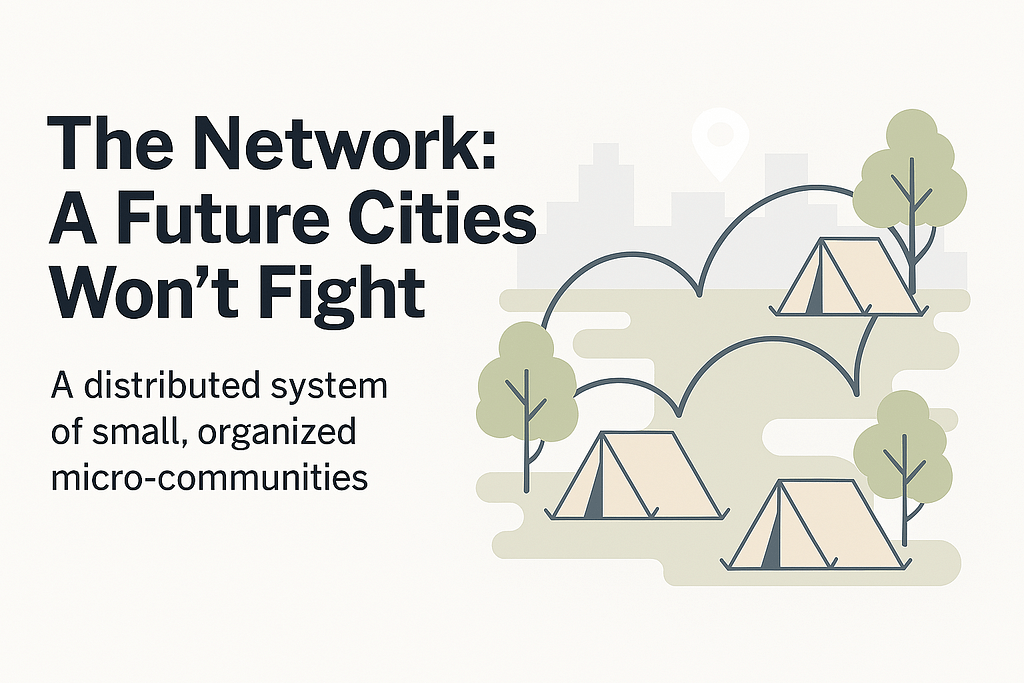
Introduction
Cities across the country struggle to balance compassion with community pressure. Large shelters trigger resistance. Encampments grow in unmanaged spaces. Neighborhoods demand action but oppose every proposed solution. This tension has shaped homelessness policy for decades, creating a cycle of stalled projects, public frustration, and unsafe conditions for people living outdoors.
A new approach is needed one that reduces fear, distributes responsibility, and creates stability without overwhelming any single neighborhood. The Network model offers a path forward: a statewide system of small, organized, low‑impact micro‑communities that operate quietly, predictably, and in alignment with community expectations.
1. The Limits of the Old Model
Traditional homelessness response relies on:
- large shelters
- centralized facilities
- high‑visibility projects
- single‑location service hubs
These models concentrate people and activity in one place, triggering community resistance and creating operational challenges. When a single facility fails or becomes overwhelmed, the entire system suffers.
The Network model replaces this fragile structure with a distributed, resilient alternative.
2. A Distributed System That Reduces Fear
The Network is built on the principle that smaller, quieter, more predictable sites create less community anxiety.
2.1 No Single Neighborhood Bears the Burden
Responsibility is shared across multiple locations, preventing the sense of being “targeted.”
2.2 Low‑Impact Sites Fit into the Landscape
Micro‑communities operate in under‑used spaces without disrupting residential areas.
2.3 Predictability Builds Trust
Clear layouts, signage systems, and operational routines create environments that feel safe and controlled.
3. A System Designed for Stability
The Network model creates stability for both residents and cities.
3.1 Micro‑Communities Support Natural Social Structures
People experiencing homelessness often form small groups based on trust and shared experience. The Network formalizes this structure, reducing conflict and improving engagement.
3.2 Distributed Sites Prevent Overcrowding
Each location serves a limited number of residents, avoiding the chaos associated with large shelters.
3.3 Flexible Deployment Allows Rapid Response
Cities can activate or deactivate sites based on need, without major construction or political battles.
4. A Model That Aligns with Community Expectations
The Network succeeds because it avoids the flashpoints that typically provoke resistance.
4.1 Quiet Operation
Small populations mean fewer crises, less noise, and minimal emergency activity.
4.2 Clean, Organized Environments
Structured layouts and sanitation systems reduce the visual impact that often fuels complaints.
4.3 Transparency and Predictability
Clear boundaries and consistent operations help communities understand what is happening and why.
5. A Path Toward Statewide Coordination
The Network is not just a collection of micro‑communities. It is a coordinated system that allows:
- shared data
- consistent standards
- unified safety protocols
- coordinated outreach
- scalable deployment
This structure supports long‑term planning and reduces the fragmentation that often undermines homelessness response.
6. Why Cities Will Support This Future
Cities are more likely to support the Network model because it:
- avoids large, controversial facilities
- reduces neighborhood disruption
- distributes responsibility fairly
- provides visible order and safety
- offers a practical alternative to unmanaged encampments
It is a model built not only for effectiveness, but for acceptance.
Conclusion
The Network represents a future where homelessness response is distributed, predictable, and community‑compatible. By replacing large, high‑impact shelters with small, organized micro‑communities, cities can reduce fear, improve safety, and create environments where people can begin to rebuild their lives.
This model offers a path forward that cities will not fight a system designed to work with communities, not against them. It is a future built on stability, dignity, and shared responsibility.